Housing.com · AI voice bot

One Enquiry, Many Homes

A buyer who asks about one home is often a fit for three more. We built a voice bot to make sure someone always asked.

Incremental leads 3,000/month CAC −30% projected Hindi · English · Hinglish
See the screens
Illustration of an AI voice bot call

ACT 1

Every enquiry is a warm lead for the house next door

When a buyer drops a lead on a project, they've told us a lot: the area they like, the configuration they want, the price they're comfortable with. That makes them a great fit for similar projects too.

So we called them. A manual calling team pitched similar properties to these buyers, multiplying one lead into several. It worked, but it was irregular and cumbersome: it depended on how many people were available, and leads waited their turn.

The opportunity was there every time. The calls just weren't.

ACT 2

Build it, or rent it first?

A voice bot could make these calls consistently and at scale. The real question was whether to build one or buy one.

Option A

Build in-house

Full control over the bot and its data.

  • We own everything
  • A decent amount of tech effort
  • No proof yet that it would work
What we chose

Start with a vendor

Prove the idea first, then decide whether to own it.

  • Fast to test with real buyers
  • Low commitment if it fails
  • Tells us what to build, if we ever build

Prove it works before you pay to own it.

ACT 3

In a voice bot, the script is the product

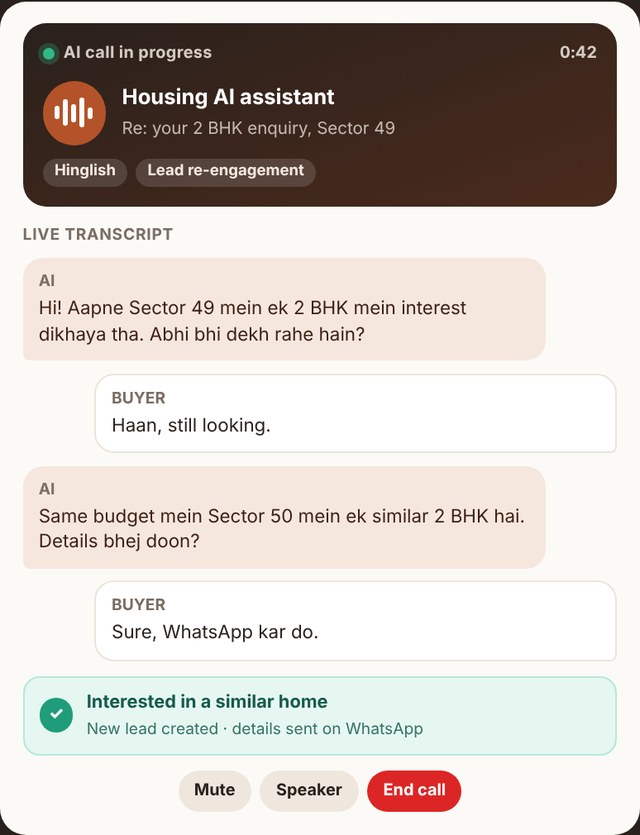
A bot is only as good as the conversation it's given. The bot greets the buyer, reminds them which property and configuration they showed interest in, then asks whether they'd like to hear about a similar property in the same price range and location.

We mapped the whole call as a decision tree: if the buyer says this, go here; if that happens, say this. Then we mapped every edge case we could find, including questions the bot couldn't answer.

A simplified version of the call flow

Greet the buyer
↓
"You showed interest in a 2 BHK in Sector 49…"
↓
Interested in a similar home nearby, in the same budget?
YES
Share matching options
Capture as a new lead
NOT NOW
Thank them and close politely
UNEXPECTED QUESTION
Safe fallback response
Logged to improve the script

Illustrative and simplified. The real tree has many more branches and edge cases.

Buyers don't all speak the same way, so neither could the bot.

The call: a natural Hinglish conversation
The outcome: one enquiry becomes another lead
The review: every batch exposes new edge cases

Illustrative wireframes and dialogue I recreated to explain the flow. Not actual Housing.com or vendor screens, and the example gaps are made up.

ACT 4

Auditioning the vendors

Buying didn't mean picking the first vendor. We tried out several and compared them on what actually decides whether a voice bot works in the real world.

📶

Connectivity rate

How many calls actually connect. A brilliant bot is useless if nobody picks up.

🗣️

Voice quality

Whether the voice and language feel natural enough that buyers stay on the line.

🔌

Testing & integration

How easily the bot plugs into our lead data and how quickly we can change it.

There were plenty of ups and downs along the way. We narrowed it down and ran the pilot with a few vendors.

ACT 5

Let real calls write the next version

You can't predict every way a real conversation will go. So instead of launching to every lead at once, we sent each vendor a small batch of leads, learned from what happened, fixed the script, and only then sent more.

How each round worked

  1. Send a small batchA limited set of leads, not the whole pool
  2. Review the callsWhat connected, what converted, where buyers dropped
  3. Find the gapsMissed edge cases and questions the bot couldn't answer
  4. Update the treeTweak the script and add new branches
  5. Grow the batchOnly once the last round held up

↺ repeat until the bot holds up at scale

Batch size grows only as confidence grows

Round 1
Round 2
Round 3
Today

Illustrative. Shows the approach, not actual batch sizes.

Each round, we judged the bot against the team it was meant to support, not against perfection.

ACT 6

Where it stands

3,000incremental leads a monthLive
−30%CAC vs the manual calling teamProjected, pilot ongoing
THE FINAL WORD

Test the idea before you build the machine

The hardest part of this AI product wasn't the AI. It was deciding what the bot should say, what it should do when it didn't know, and how much to trust it before giving it more. Starting with a vendor and small batches let real buyers teach us all three, cheaply.

Read another case study Get in touch